
One frightening night changed the way I understood dementia—and ultimately led me to create a simple way to help others respond with greater patience, safety, and compassion.
By Vicki Bradley-Seals
“The best way to not feel hopeless is to get up and do something.” -President Barack Obama.
Do something.
Do. Something.
That ‘something’ for me evolved from a 2 a.m. interaction with police that could easily have ended my life and the lives of my parents.
Let me explain.
The Birth of an Idea
There are ideas for inventions that begin through casual conversations.
Some are developed in laboratories.
Still others refined in boardrooms.
But then, there are innovations that begin in a lived experience.
The kind that creates a gripping fear you never want to revisit.
A fear you don’t want others to experience either.
Several years ago, my elderly parents had begun to experience cognitive changes.
I was helping them as needed, and I wasn’t terribly concerned, until one night I became seriously concerned.
The 2:30 A.M Experience
One day my phone rang around 2:30 in the morning.
I immediately recognized it to be my parents’ alarm company.
The operator informed me the alarm had been triggered by the opening of the front door; someone was entering the incorrect code repeatedly; and there was no response when the operator spoke through the panel.
The police were on their way.
Living just a couple of blocks away, I rushed over.
When I pulled into the driveway…
- the alarm was still blaring,
- the house was completely dark,
- the front door was wide open, and
- the only light was from a floodlight outside.
I left my car running, door open, and I went inside – concerned only for my parents’ safety.
I looked down one hallway and saw nothing.
But then I saw what appeared to be a flashlight moving in my parents’ bedroom.
When I reached the door of their bedroom, I saw my mother in bed with covers over her head and my father rummaging through a drawer in his nightstand using a flashlight.
“Daddy, what are you doing?” I asked.
“I’m looking for the code to the alarm,” he said with clear frustration.
As I disarmed the system using the keypad in their bedroom, I asked, “Why do you have a flashlight?”
“I didn’t want to wake your mother,” he answered.
When the alarm stopped, Mom pulled the covers over her face.
And then I heard them.
Still standing at the door to their bedroom, I heard the police approaching.
I stepped outside of the bedroom to see them walking up to the front door with their hands
resting on their weapons.
I quickly turned on the hallway light and informed them that everything was okay.
I let out a massive sigh of relief.
An incredibly tense moment passed.
But as I drove home later that night, I realized something else had begun. I couldn’t stop thinking about what might have happened if I hadn’t arrived first.
What I Couldn’t Forget
Although I stayed for several minutes before leaving, I wasn’t confident I knew the series of events that led to the triggering of the alarm that night.
But here’s what I do know…
For several weeks afterwards, I couldn’t stop replaying in my head the events of that night.
I wasn’t thinking so much of what happened but more of what could have happened.
Consider This Instead
(Scripted sequence – where police arrive first)
At 2:30 a.m., a residential alarm is triggered.
The alarm monitoring center notices there is a breach at the front door of the residence followed by several incorrect attempts to disarm the system. The operator speaks through the panel, asking, “Is everything okay?” “Do you need assistance?” But there is no response.
The operator then escalates the call by contacting police dispatch, providing the facts.
Dispatch sends officers to the home. The call center contacts me, the Key Holder, explaining the sequence of events.
Police arrive. The house is dark, the front door is open, and the alarm is blaring.
There is no one outside. The police respond based on the information provided by the monitoring company.
From the police perspective, the situation is potentially active.
They approach cautiously, with hands resting on their weapons.
They enter the home.
The alarm continues.
The house is dark.
They have never been inside, so they are not familiar with the residents of the home nor the home’s layout.
As they move further, they see what they determine to be a flashlight flickering in a bedroom.
They walk in that direction, simultaneously scanning the spaces they walk through.
When they reach the bedroom, they see a visibly frustrated male anxiously searching through a nightstand drawer with a pistol in plain view.
Suddenly, a figure under the covers on the bed moves, and from behind them comes another person through the front door asking, “What’s going on?”
From the perspective of the police, they see…
- A possible home invasion.
- Unpredictable movement.
- A man they do not know.
- Weapon within reach.
- An unannounced, unexpected person entering the home.
They do not see a husband, a father, a grandfather trying to solve a problem.
They do not see a person searching for an alarm code.
They do not see a man who chose a flashlight so he wouldn’t wake his wife.
They do not see a wife under the covers wanting the noise to stop.
They do not see a frantic daughter awakened in the middle of the night, arriving to check on her elderly parents.
They do not see this as a cognitive situation.
They see it as a criminal one.
Without context, there is no way for them to make the distinction.
What That Moment Revealed
Every day, for several days, various scenarios of this incident were recurring thoughts.
I felt the vulnerability of my parents as they entered a stage of life where their actions might not always make sense to others.
I didn’t want my parents to be misunderstood and therefore mistreated. That night I realized dementia wasn’t only changing my parents. It was changing how the world interpreted them. I didn’t want an innocent moment to turn into one of serious injury… or death.
Because who…
- uses a flashlight
- in their own house
- while the alarm is blaring
- to look for an alarm code in a drawer
- because they don’t want to wake their wife?
Mom wasn’t deaf.
Not Just One Moment
The same vulnerability showed up in a lot of ordinary, everyday moments for us.
In restaurants.
In retail stores.
At appointments.
All in real time.
When my mother would repeat herself.
The same story.
The same question.
The same joke.
When my father would forget a word or use the wrong word.
He meant to say ‘yes’ to questions, but instead said ‘no.’
He would use the wrong word.
He was met with confusion or condescension.
I never wanted to interrupt my parents and explain their condition to others in front of them. But it was also difficult to say nothing and allow the misunderstanding to fester.
So, I did my best to bring compassion and clarity to unexpected encounters with others.
But even when I attempted to prepare others ahead of time, it would often fall flat.
At non-neuro appointments, I would clearly explain what was happening before we arrived, but staff weren’t notified, and providers weren’t often prepared.
They would still ask questions of my parents that neither could accurately answer.
It hurt to see the confusion on my parents’ faces.
It was heartbreaking to see the frustration on the faces of the providers.
Some Solutions Fall Short
There are business-sized cards created to help bridge the gap and used to explain a person’s dementia to others. The idea is the caregiver hands the card to a server, etc., making them aware of the condition.
The intention is good.
But in real life, cards fall short in those moments when they are needed most.
Encounters don’t always happen in controlled environments. They often happen unexpectedly without time to hand a card or explain anything at all.
Encounters are not on HOLD while you search for a card.
These encounters do not PAUSE while the card is read.
The encounters do not SLOW DOWN while you explain.
Encounters often happen immediately, leaving no opportunity for context or action.
What Was Missing
What was missing was not compassion.
It was a simple, readily recognizable symbol that precedes explanation.
Something instant.
Something visible.
Something that quickly and quietly says:
There is more happening here than what you see or hear.
Doing Something
That realization became the beginning of hope.
That hope became Dementia Guardian.
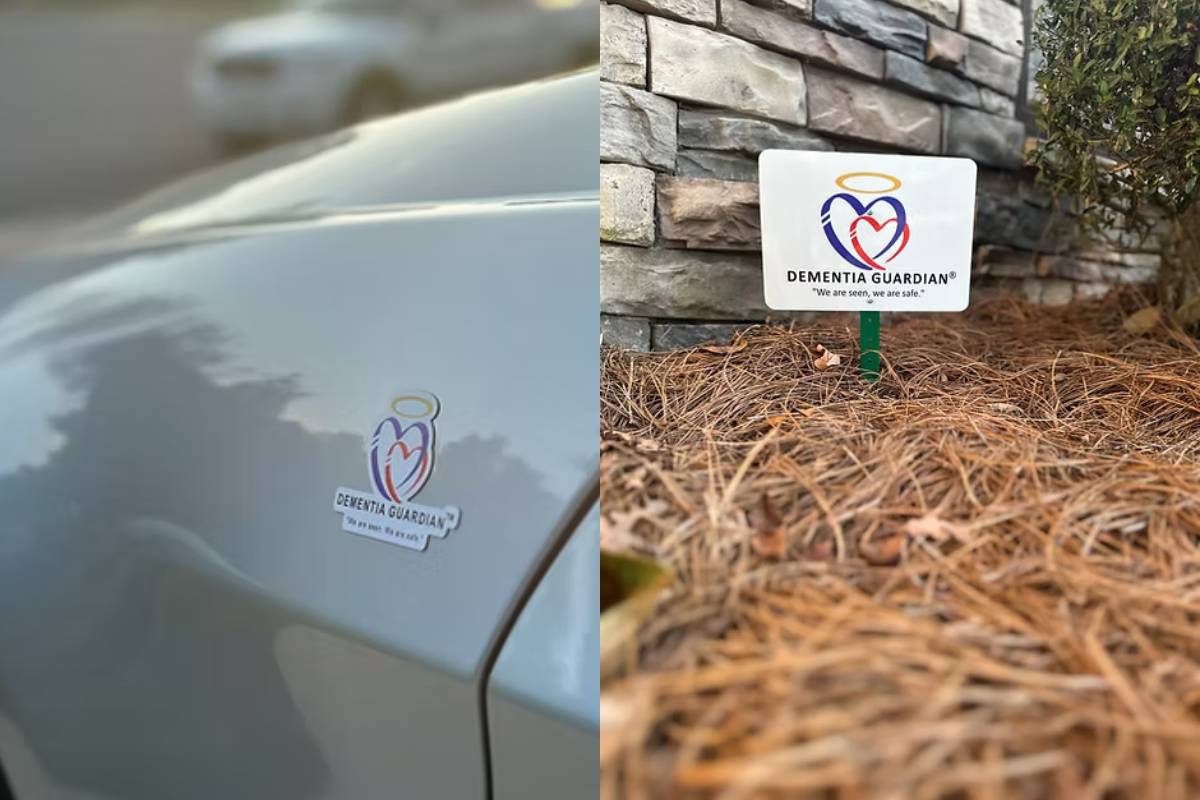
A simple, visible, and recognizable symbol—worn by a caregiver or placed visibly at a home— that signals in real time that a person is living with dementia and may need patience, awareness, and understanding.
Awareness and understanding.
Not after confusion begins.
Not after frustration builds.
But at the very beginning of the interaction itself, immediately placing others on notice to
understand that a person is living with dementia.
Because if a signal had existed that night at my parents’ home, the situation could have been understood before anyone stepped inside.
And in countless everyday moments since, it could have changed the way people responded—not with judgment or confusion, but with clarity, care and compassion.
Why It Matters
Dementia Guardian exists for those moments.
To replace uncertainty with understanding.
To replace misunderstanding with compassion.
Because dementia does not wait for convenience.
It does not pause for preparation.
It does not announce itself in advance.
And it does not unfold only in controlled environments.
It happens in restaurants.
In retail stores.
At medical appointments.
In homes during emergencies.
And it is in those moments—real, unpredictable, fast-moving moments—that immediate understanding matters most.
Because people respond to what they understand. When they have more context, they can respond with greater patience, confidence, and compassion.
Dementia Guardian is one small way to provide that context.
I invite you to learn more, share it with others, and help bring this simple signal into the places where it can make the greatest difference. Visit www.dementiaguardian.com for more information.